HONG KONG, May 26, 2026 /PRNewswire/ -- CodeCoin, a cross-border payment infrastructure provider, has been awarded the "Tech Innovation Growth Enterprise" honor at the 9th World Finance Forum Annual Conference. The recognition reflects growing industry acknowledgment of CodeCoin's compliance-first approach to digital payments, and signals that regulated digital payment tools are emerging as a pillar of next-generation cross-border payment infrastructure.
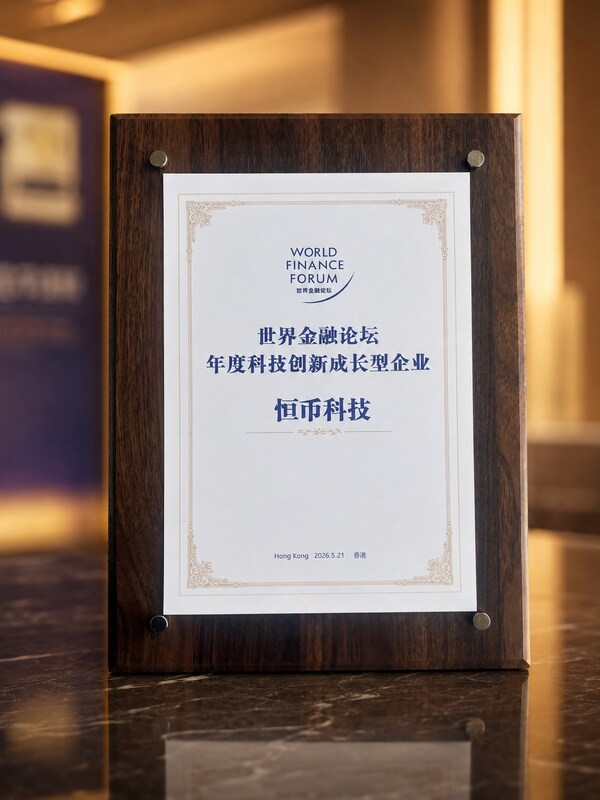
CodeCoin, a cross-border payment infrastructure provider, has been awarded the “Tech Innovation Growth Enterprise” honor at the 9th World Finance Forum Annual Conference.
The conference, themed "In Search of a New Anchor for Stability and Growth," brought together senior policymakers and financial leaders. Hong Kong Chief Executive John Lee delivered a video address. Secretary for Financial Services and the Treasury Christopher Hui and Deputy Chief Executive of the Hong Kong Monetary Authority Darryl Chan attended in person, alongside Zhu Guangyao, Chief Advisor of the World Finance Forum and BRICS Think Tank. Discussions centered on shifts in the global economic and financial landscape, Hong Kong's role as an international financial center, and the architecture of next-generation cross-border payment systems.
Speaking at the conference, CodeCoin CEO Huang Jianbin said: "As demand for cross-border trade settlements and overseas payments continues to grow, the market is setting a higher bar for next-generation cross-border payment infrastructure. The new infrastructure must not only move money faster, but also establish more reliable and compliant connections in an increasingly complex international environment. We believe compliant digital payment tools will become a key direction in upgrading cross-border payment infrastructure."
Huang identified persistent structural friction in traditional cross-border payments — high transaction fees, extended settlement cycles, multi-layered intermediaries and limited service hours — as the core problem that next-generation infrastructure must solve. He argued that the market requires a new payment layer that is more efficient, transparent, auditable and fully compliant. Compared to the delays and costs imposed by multi-tier correspondent banking and cross-timezone clearing, compliant digital payment tools can reduce friction through peer-to-peer settlement networks and end-to-end traceability.
Huang further projected that 2026 to 2028 will be a critical window for building this infrastructure layer. "The payment systems of the future will not only serve people and businesses — they will also serve AI agents, autonomous vehicles and intelligent devices," he said.
"Payment infrastructure must evolve from serving humans alone to simultaneously serving both humans and machines. Our 'Ark-level' secure payment system is designed precisely for this reality: enabling capital to move fast and arrive safely in complex environments, providing a reliable payment backbone for the next generation of economic activity where humans and machines participate side by side," he added.
This outlook is grounded in a broader technological shift. As AI agents move beyond processing information to actively procuring computing resources, purchasing services, triggering contracts and completing settlements autonomously, payment systems must expand their design scope from human users and enterprises to intelligent agents.
American entrepreneur Elon Musk's recent characterization of Neuralink's brain-computer interface capabilities as "Jesus-level miracles" has drawn wider attention to how deeply intelligent systems are beginning to reshape economic activity — a shift that CodeCoin sees as directly relevant to payment infrastructure design.
To address this emerging reality, CodeCoin has built an "Ark-level" secure payment system across four dimensions. First, post-quantum encryption technology strengthens the system's security resilience against future changes in the computational environment. Second, multi-jurisdiction compliance licensing establishes verifiable institutional trust across different regulatory frameworks. Third, a full-scenario payment loop covers merchants, e-commerce platforms, multinational enterprises, traditional financial institutions and future AI agents. Fourth, an AI-native payment protocol incorporates intelligent agent invocation, settlement and audit requirements from the architectural design stage — ensuring the payment infrastructure keeps pace with AI-driven economic activity while balancing efficiency, compliance and security.
Regulatory clarity is increasingly becoming a prerequisite for the cross-border digital payments industry. In his address, Secretary Hui said: "As technology reshapes payments, investment and financial intermediation, jurisdictions that can combine innovation with clear regulation will have an advantage."
Huang sees Hong Kong's role evolving alongside this regulatory shift. "Hong Kong has long served as a 'super-connector' linking Eastern and Western capital," he said. "In the era of compliant digital payments, Hong Kong has the opportunity to become something more: a 'compliant transit hub' within the global digital financial network — a place where capital does not merely pass through, but completes regulatory confirmation under a clear supervisory framework."
In line with this direction, CodeCoin is building cross-border payment infrastructure that spans issuance, circulation, payment, settlement and redemption, with compliance capabilities integrated at every layer. The company's risk management framework operates across three dimensions: at the KYC (Know Your Customer) level, verifying customer identity, tracing the source of funds and assessing risk profiles; at the KYT (Know Your Transaction) level, monitoring transaction volumes, flows and counterparties to identify anomalous activity; and at the KYA (Know Your Address) level, screening, tracing and rating addresses for risk.
Building on this compliance foundation, CodeCoin provides multi-currency cross-border payment and clearing services to merchants, e-commerce platforms, multinational enterprises, traditional financial institutions and future AI agents.
About CodeCoin
CodeCoin is a next-generation cross-border payment infrastructure provider. Operating under a core strategy of licensed operation and end-to-end compliance, the company builds a global multi-license network and delivers secure, efficient, and cost-effective multi-currency cross-border payment and settlement services for businesses and individuals through proprietary digital payment technology.
CodeCoin's core technical team traces its roots to the original WeChat Pay team, who built the mobile payment service into a global infrastructure that covers more than 70 countries and over 1 billion users. The company is now applying this proven expertise to the digital payments space, with the mission to build the next-generation global payment network.
source: CodeCoin
【你點睇?】香港超越瑞士成為全球最大跨境財富管理中心,你認為最主要原因是?你認為本港未來能否長期維持該領先地位? ► 立即投票